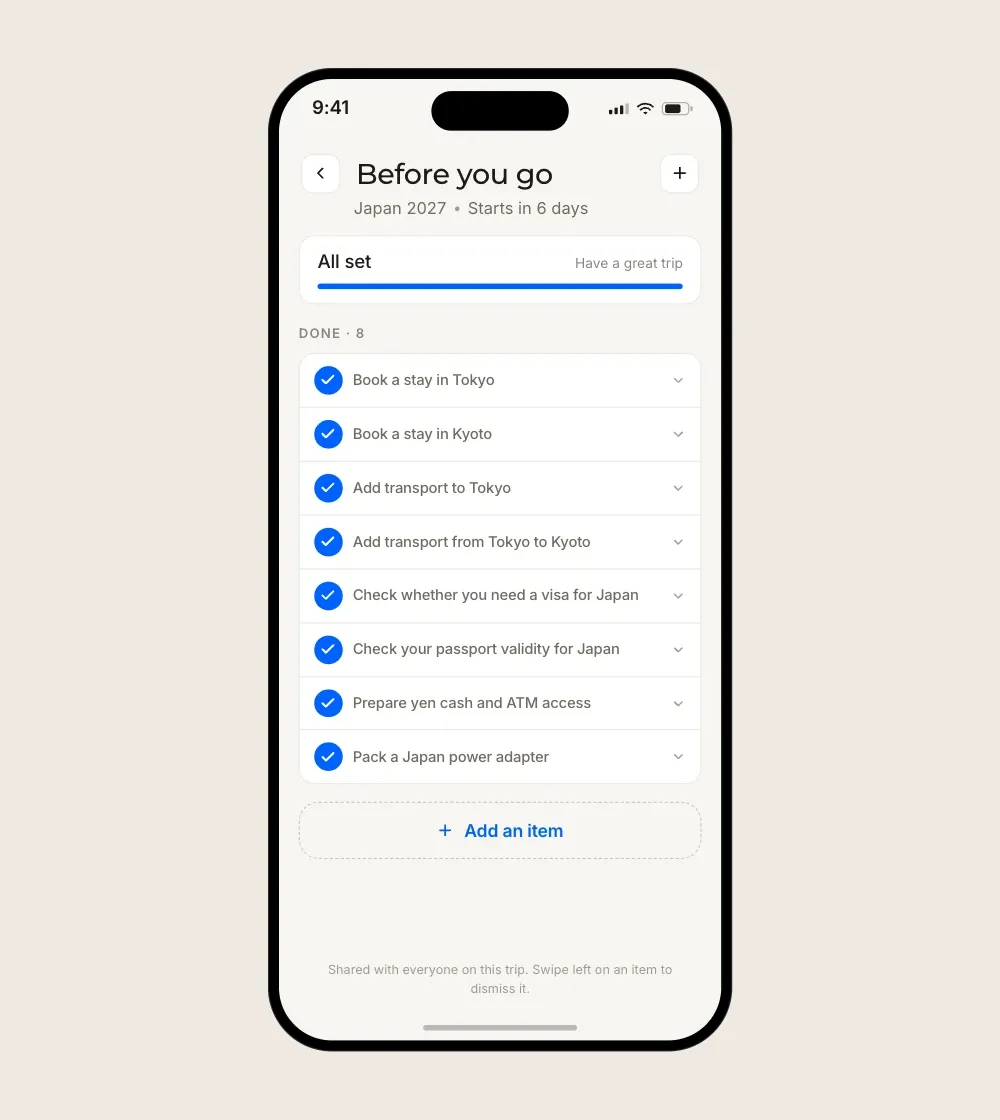
Before you go: the pre-trip checklist that fills itself in
Floki now builds a pre-trip checklist from where you live, where you are going, and what the itinerary still lacks. Shared with everyone travelling with you.
Three days before a trip, most people run the same loop. Is the passport still valid. Do I need a visa for this one. Will my card work there. Did anyone actually book the second hotel.
The loop is not hard. It is just easy to lose track of, and it lands right when you are busy with everything else. So Floki now keeps that list for you, one per trip, shared with everyone travelling with you.
It is called Before you go, it is free, and you do not have to write it.
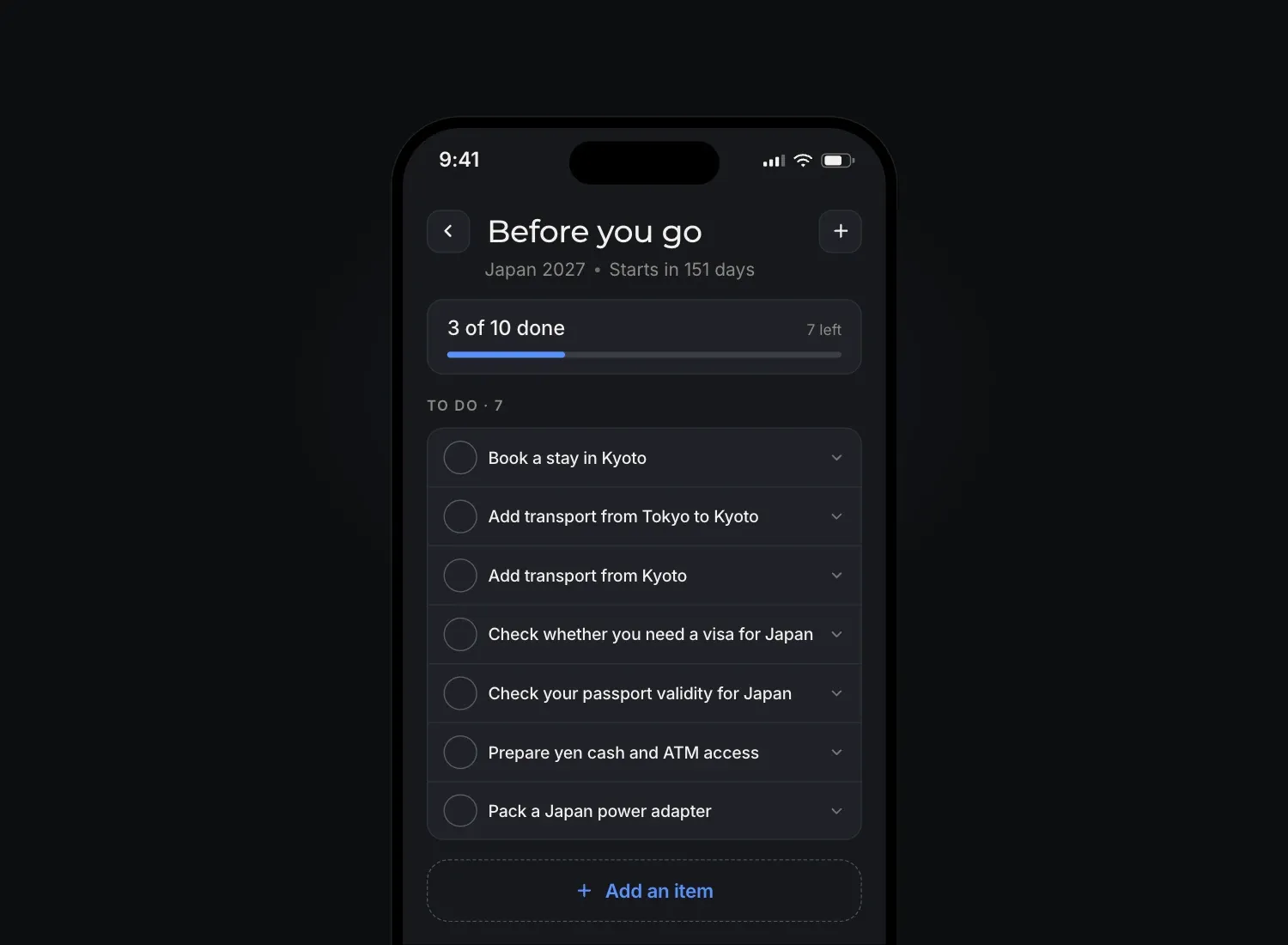
What ends up on the list
Two different kinds of thing, from two different places.
Gaps in the trip itself. Floki can see that your trip has two stops and only one hotel. It can see there is no train booked between them, and no flight home from the last city. Those become items: book a stay in Kyoto, add transport from Tokyo to Kyoto, add transport from Kyoto.
What the trip asks of you. This is the part you cannot see by looking at your itinerary. Floki looks at where you live, your nationality, where you are going and when, and works out what a person in your situation actually has to sort out before leaving.
Then there is a third source: you. Anyone on the trip can add their own item, and it shows up for everyone with their name on it.
The same feature, two very different lists
This is the part worth explaining, because it is what separates a real checklist from a generic one.
A traveller living in Brazil, going to Tokyo and Kyoto in November, gets a list like this:
- Check whether you need a visa for Japan
- Check your passport validity for Japan
- Check Japan’s rules on bringing medication
- Prepare yen cash and ATM access
- Pack a Japan power adapter
The same traveller, taking a long weekend in Recife, gets this instead:
- Pack mosquito repellent
- Pack for hot, humid coastal weather
No passport. No visa. No adapter. No roaming advice. A domestic weekend does not need any of it, so Floki does not put it there.
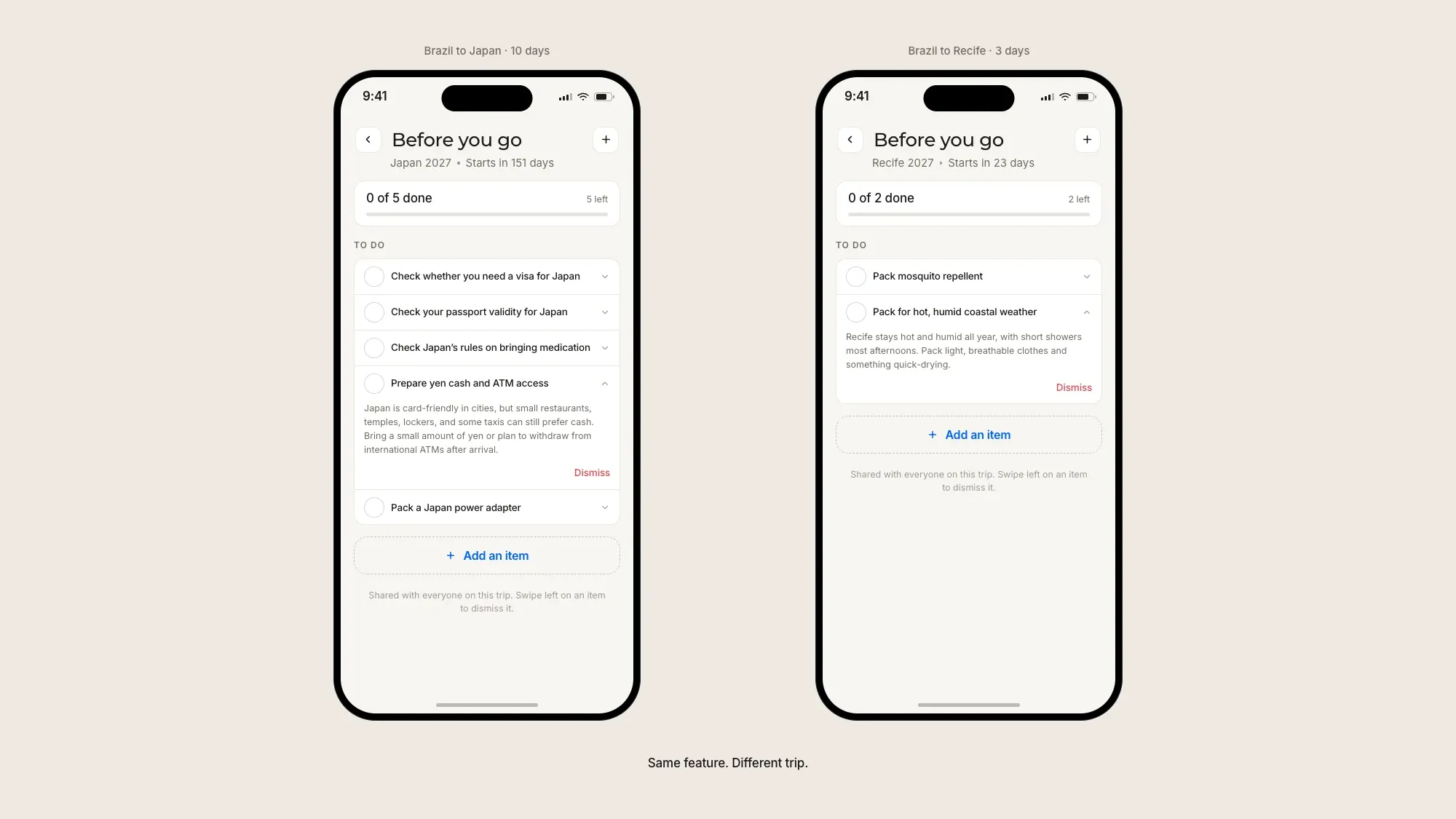
That difference is the whole point. A checklist that gives everyone the same twenty items is a checklist people stop reading by the second trip.
It tells you what to check, not what the rule is
You will notice the wording. Floki says “check whether you need a visa for Japan”, not “you do not need a visa for Japan”.
That is deliberate. Entry requirements, passport validity rules and medication restrictions change, and they change per nationality. What Floki is good at is knowing that a Brazilian passport holder flying to Japan has a question to answer here, and that the same person flying to Recife does not. Answering it is a thirty second search once you know to look. Missing the question entirely is what ruins a trip at the airport.
Same for the practical items. Floki does not claim to know today’s exchange rate. It knows that plenty of small restaurants, temples and buses in Japan still take cash only, and that this surprises people who have not carried notes in years.
Half of it ticks itself
The items about your itinerary are connected to your itinerary.
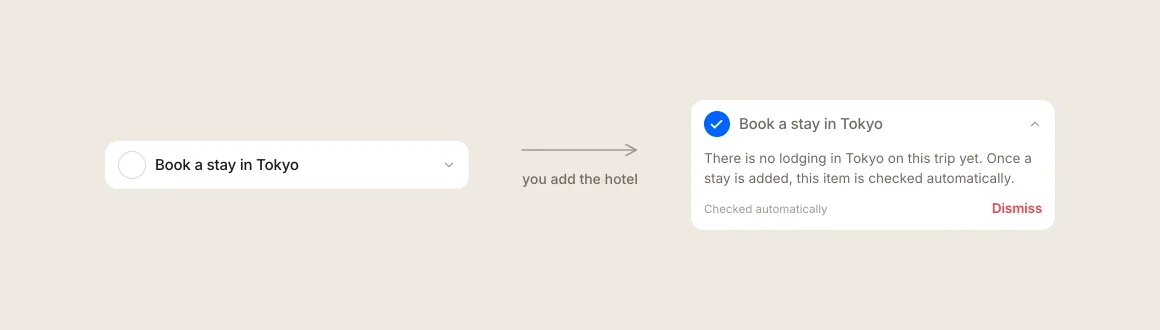
Add a hotel in Tokyo, and “Book a stay in Tokyo” ticks itself. The row moves to Done and says Checked automatically, with no name attached, because no person did it. Remove that hotel later and the item quietly comes back.
So the list stays honest without anyone maintaining it. As your trip fills in, the checklist empties out.
Everyone on the trip sees the same list
If you are travelling with other people, you are already splitting the admin. One person is on flights, another on hotels, someone else always ends up doing the visas.
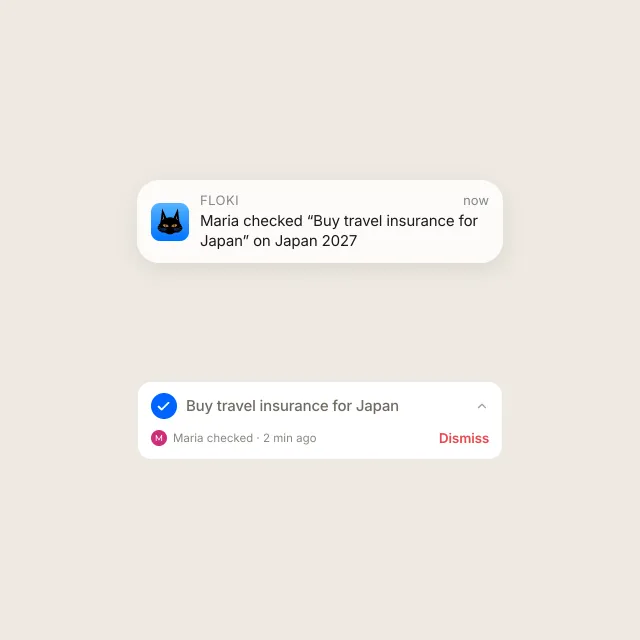
The checklist is shared. Any member can tick, untick, add or dismiss an item, and every row shows who did the last thing and when. Tick something off and the others get told, so nobody buys travel insurance twice.
If someone runs through five items in one sitting, that arrives as a single notification saying they checked five items, not five separate buzzes. Automatic ticks never notify anyone, because a hotel booking is not news twice.
Short on purpose
A trip with one or two stops gets around five suggested items. Longer trips get a few more, and the list is capped.
That is a deliberate limit. A checklist with forty items is a document, and people do not run documents the night before a flight. Five to eight things you can actually finish in one sitting is a checklist.
You can also dismiss anything that does not apply to you. It goes away for everyone on the trip, with a few seconds to undo, and Floki does not suggest it again.
Where to find it
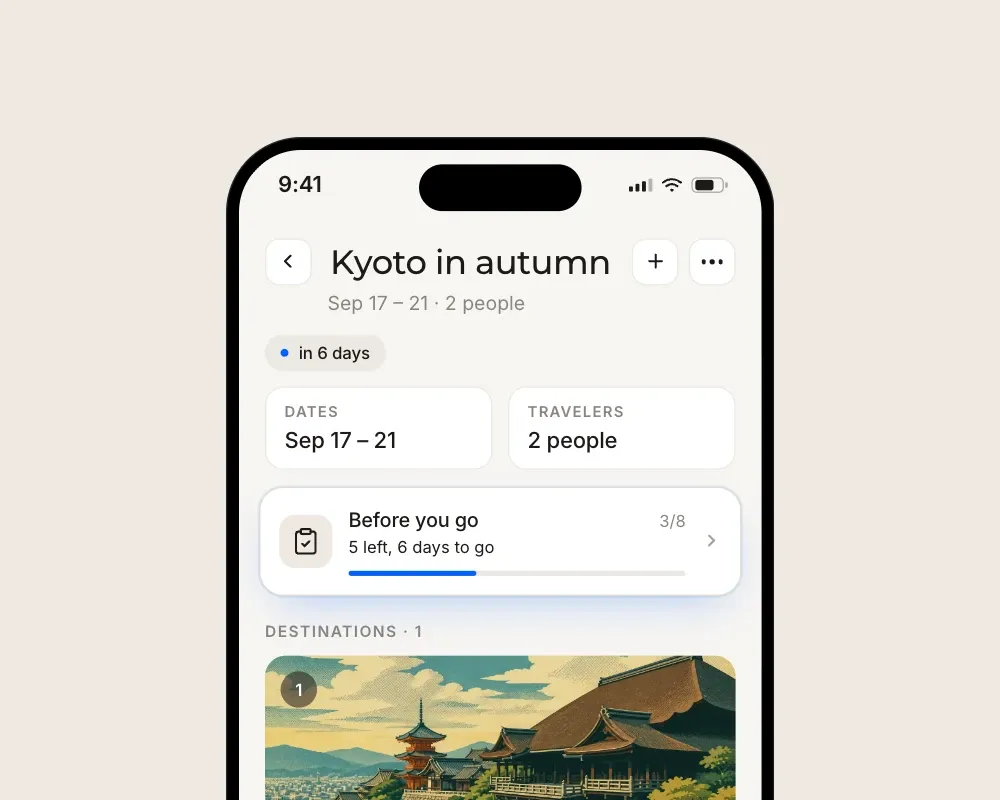
Add your destinations to a trip. Once the trip has stops, a Before you go card appears on the trip page, between your dates and your destinations, with a progress bar and how many days you have left.
Tap it, and the list is there. Tick as you go. Add your own. Swipe left on anything you do not need.
Questions people ask
Do I have to build the list myself? No. Floki writes it as soon as your trip has destinations. You can add your own items on top of it.
Does it work for trips inside my own country? Yes, and it stays quiet. Domestic trips get the few things that actually apply, usually about weather or health, and nothing about documents.
What happens when I book something? The matching item ticks itself and says it was checked automatically. If you cancel, it comes back.
Can the people I travel with see it? Everyone on the trip sees the same list and can change it. Each row shows who did the last thing.
Will it spam me with notifications? No. Ticks from one person inside the same short window arrive as one notification. Automatic ticks send nothing at all.
Does it cost anything? No. Before you go is part of every trip in Floki.
The point of it
Nobody enjoys the week before a trip. There is a version of it where you are excited, and a version where you are lying awake trying to remember whether your passport expires in March or May.
Floki cannot book your hotels for you. It can make sure that by the time you are at the gate, nothing on the list is still open.